Quick answer: Compare sewer-repair bids by the defect they will fix, the exact pipe section covered and the finished condition of your property—not just “trenchless” versus “digging.” Every proposal should identify inspection findings, repair endpoints, materials, access work, permits, testing, restoration and exclusions. Lining and pipe bursting have different limitations; neither should be selected without checking the existing pipe and site conditions. (nepis.epa.gov)
This guide is for U.S. homeowners comparing residential sewer-repair proposals. Seattle requirements provide a local example, not a nationwide rule. No national price average or property-specific cost estimate is assumed.
1. Start with inspection evidence and a defined repair boundary
Before comparing methods, ask each contractor to explain what failed, where it failed and which portion of the sewer needs work.
Request a copy of the inspection footage and a written findings summary. Ask for:
- The inspection date, access point and direction of travel.
- The distance reference used in the recording.
- Pipe material and diameter where identifiable.
- Locations of visible cracks, roots, displaced joints, standing water or collapse.
- Sections that could not be inspected and why.
- Proposed repair start and end points, marked on a property sketch.
EPA guidance identifies lateral-camera inspection as a way to investigate leaks, changes in pipe material or diameter, sags and bends. But inspection and locating are separate tasks: request an explanation of how the contractor established the proposed work’s surface location and depth. (nepis.epa.gov)
Do not accept “replace the sewer” as a complete scope. Ask whether the proposal covers a localized defect, a longer damaged section or the entire private lateral. Also clarify whether the connection to the public main is included.
For a shared sewer, ask the sewer authority to confirm responsibility before authorizing work that affects neighboring properties.
2. Separate lining, pipe bursting and open-cut excavation
“Trenchless” describes a category, not a single repair.
| Method | What it does | What the bid should explain |
|---|---|---|
| Cured-in-place pipe lining, or CIPP | Installs and cures a resin-saturated tube inside the existing pipe. | Preparation, liner system, repair limits, access, connection treatment and acceptance checks. |
| Pipe bursting | Breaks or splits the existing pipe while pulling replacement pipe into its path. | Replacement pipe, access pits, equipment access, utility conflicts and reconnections. |
| Open-cut excavation | Exposes the pipe so the specified section can be repaired or replaced. | Excavation limits, pipe installation, bedding, backfill, testing and surface restoration. |
These are distinct processes. A lining proposal should not be treated as equivalent to replacement simply because both are described as creating a “new pipe.” (nassco.org)
Ask the contractor to explain why the recommended method suits the documented defect. If proposals recommend different repair lengths, settle that difference before comparing their totals.
A combination may deserve consideration: ask whether a localized excavation is needed before a longer section can be lined, and request separate pricing for that preliminary repair.
3. Check the limitations behind a trenchless recommendation
A trenchless proposal needs a feasibility explanation, not just a promise of less disruption.
For lining, ask about the existing pipe’s shape and alignment. EPA’s lateral-rehabilitation guidance identifies sags, large joint offsets and numerous bends as limitations for standard cured-in-place liners. A liner is not a means of enlarging the existing sewer or removing a sag. (nepis.epa.gov)
Ask the bidder:
- Does any section need excavation before lining?
- How will diameter changes and bends be handled?
- What finished internal diameter is proposed?
- Which connections require treatment?
- What finding would make the proposed installation unsuitable?
For pipe bursting, ask about material, soil, bends and nearby infrastructure. NASSCO’s rehabilitation matrix identifies soil conditions, burial depth, tight or multiple bends and access as constraints. It also states that the existing pipeline’s line and grade remain; do not assume bursting will correct an alignment problem. (nassco.org)
Seattle’s infrastructure guidance likewise calls for considering nearby utilities, foundations, surface improvements and pipe depth, and notes that dense or rocky soil can limit some rehabilitation methods. That guidance concerns infrastructure design, not automatic approval for an individual home. (ci.seattle.wa.us)
Have the contractor put the feasibility assumptions—and the response if those assumptions prove wrong—in writing.
4. Require a site-access and excavation scope for either approach
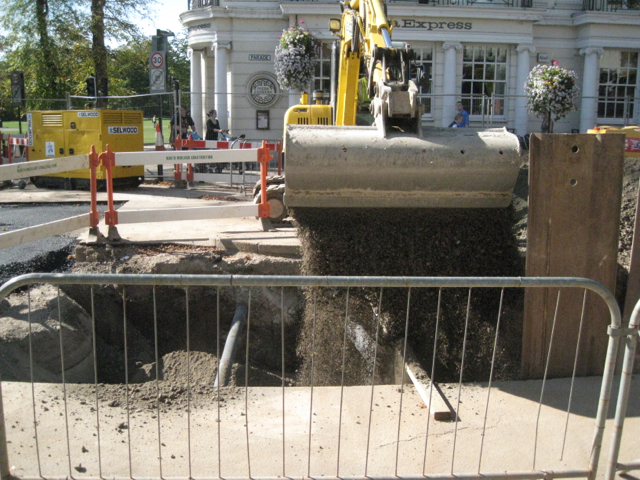
Less surface disturbance does not mean no excavation. EPA’s pipe-bursting guidance identifies insertion-pit requirements and potential ground movement among the method’s limitations. It also warns that unforeseen underground utilities can increase time and project risk. (epa.gov)
For either trenchless work or open-cut repair, request a sketch showing:
- Every proposed pit or trench.
- Equipment entry and staging areas.
- Pavement, fencing or landscaping to be removed.
- Areas requiring utility investigation.
- Access needed to neighboring land or public property.
Ask for written treatment of depth assumptions, groundwater management, excavation protection, spoil removal and disposal. These are questions for qualified contractors, not homeowner excavation instructions.
Require a plan for keeping wastewater service available—or identifying when it will be unavailable. Ask what water-use restrictions apply, how you will receive notice and whether temporary flow handling is included.
For open-cut work, request pipe material and size, connection details, bedding and backfill specifications, and the intended slope or elevation correction where relevant. Do not let “excavate and replace” stand in for those details.
5. Verify local approval, permits and inspection requirements
Ask your sewer authority which methods and materials it accepts for your address. Then require the bid to identify who obtains permits, pays fees, schedules inspections and supplies completion records.
Seattle illustrates why this matters. Its published side-sewer rule allows lining and pipe bursting using materials compatible with the existing pipe’s diameter and type. The rule also requires a side-sewer permit and inspection for repairs using either method. These are Seattle provisions, not universal U.S. requirements. (seattle.gov)
Seattle separately explains that liner installations require live camera inspection and that the liner must not extend into the public sewer main. A proposal reaching the main should therefore explain its termination and inspection arrangements. (buildingconnections.seattle.gov)
Public-space costs need attention too. Seattle’s Street Use guidance, updated August 4, 2026, covers side-sewer work and staging or restoration in the right-of-way; relevant departmental fees are collected separately. “Permit included” should specify which permits and fees. (seattlegov.zendesk.com)
For your project, request confirmation of:
- Required sewer and public-space approvals.
- Inspection and testing stages.
- Any required installer qualifications.
- Completion drawings or other records.
- Responsibility for correcting rejected work.
6. Define restoration by surface and finished condition
Do not accept “backfill included” as your entire restoration agreement.
Instead, ask the contractor to list what will be removed and what will be returned to its finished condition:
| Area | Details to request |
|---|---|
| Lawn or planting bed | Grading, topsoil, seed or sod, and planting exclusions. |
| Concrete | Removal limits, replacement area, finish and responsibility for adjacent damage. |
| Asphalt | Temporary versus permanent restoration and the area included. |
| Pavers | Storage, reinstallation, base work and replacement of damaged units. |
| Irrigation or fencing | Removal, reconnection or reinstallation, and final checks. |
| Public sidewalk or street | Approved restoration scope, responsible party and outstanding fees. |
Ask who handles settlement or restoration defects, for how long and under what written terms. If a separate paving or landscape contractor is needed, obtain that scope before deciding which sewer bid is cheaper.
This is an application of the FTC’s advice to obtain a written contract describing the work, materials, price, timing and handling of changes. Do not rely on a verbal promise that the yard or driveway will be “put back.” (bulkorder.ftc.gov)

7. Worked comparison: equalize exclusions before choosing
Consider this scope-only example, not actual quotations or a price estimate. Assume the contractors have confirmed that their proposed methods address the same documented problem and repair endpoints.
| Item | Lining proposal | Pipe-bursting proposal | Excavation proposal |
|---|---|---|---|
| Preparation | Cleaning included | Preparation included | Excavation and replacement included |
| Access | New access work excluded | Pits included | Trench included |
| Surface finish | Access-area restoration excluded | Backfill included; paving excluded | Defined pavement and lawn restoration included |
| Permits and closeout | Must be confirmed | Must be confirmed | Must be confirmed |
Work through the comparison in this order:
- Complete the lining scope: obtain a written price for required access work and its restoration.
- Complete the bursting scope: obtain a paving proposal covering the actual disturbed area.
- Check the excavation scope: confirm that its stated restoration covers every affected surface.
- Resolve shared gaps: confirm permits, inspection, testing, disposal and completion footage for all proposals.
Use this comparison structure:
Comparable project total = quoted work + required excluded work + separately contracted restoration + other required charges not already included.
Do not count the same item twice. Keep allowances and unresolved conditions clearly marked rather than treating them as fixed prices.
The result is a more complete comparison—not proof that one method wins. If suitability or scope still differs, the totals remain non-equivalent.
8. Use this checklist before signing and at closeout
Before signing, collect:
- Inspection footage and written findings.
- Marked repair endpoints and stated length.
- Proposed method, materials and suitability explanation.
- Access, excavation and utility-investigation scope.
- Permit, inspection and testing responsibilities.
- Itemized restoration and explicit exclusions.
- Written pricing or allowances for unresolved work.
- Payment milestones, schedule and change-order procedure.
- Written warranty terms, exclusions and claim process.
Verify locally required credentials with the relevant authority. The FTC recommends checking applicable licensing requirements, obtaining several written estimates and asking why prices differ rather than automatically choosing the lowest bidder. (bulkorder.ftc.gov)
At closeout, request the agreed completion footage, inspection approvals, test results, warranty documents and repair-location record. Check that the recorded work matches the contracted endpoints and that any exclusions remain clearly identified.
The best bid is the suitable repair with a complete, understandable scope—not necessarily the shortest trench or the lowest headline price.