Quick answer: A leaking shower does not automatically need a new valve behind the wall. For an identified valve, manufacturer troubleshooting may call for a replacement cartridge. But cartridge repair, valve-body replacement and wall restoration are different scopes. Before comparing quotes, ask what failed, which parts will remain, whether the wall must open and who will restore it. Manufacturer guidance is specific to the valve—not just the visible symptom. (solutions.moen.com)
1. Separate the cartridge, valve body and decorative trim
“Replace the shower valve” is too vague for a useful estimate. Ask the plumber to distinguish these components:
| Component | What the quote should identify |
|---|---|
| Cartridge or service parts | The replaceable internal assembly and exact replacement part number |
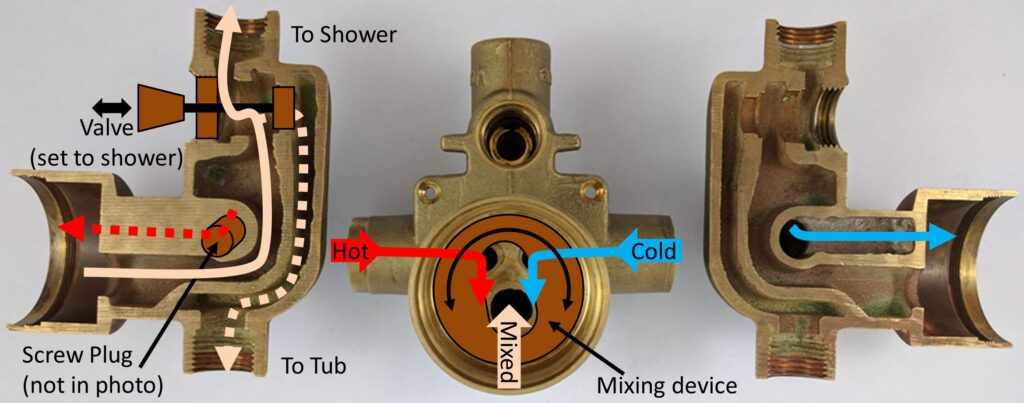
| Valve body | The concealed assembly connected to the plumbing |
| Trim | The visible handle, backplate and related finish pieces |
Manufacturer documentation treats these as distinct items. For example, Moen identifies different cartridges for different shower-valve families. Delta’s R10000-UNWS product page lists the valve body separately from the trim kit and says its cartridge ships with the trim. A box labeled “valve” therefore may not contain everything needed for the finished installation. (solutions.moen.com)
Start your comparison with one question:
“Does this proposal replace service parts inside the existing body, or remove and replace the body and its plumbing connections?”
Then ask whether the existing trim will be reused. Treat a cosmetic upgrade as a separate decision unless the proposed repair requires different compatible components.

2. Document the leak without diagnosing it yourself
Before the appointment, record where water appears and when:
- Does the showerhead drip briefly after use, then stop?
- Does it keep dripping with the handle off?
- Is water visible around the handle or backplate?
- Does water come from the showerhead only while filling the tub?
- Have you noticed dampness on the other side of the wall?
These observations help the plumber choose the right troubleshooting path. They do not prove which component failed. Delta explains that brief dripping after shutoff can be the showerhead emptying retained water. By contrast, Moen’s guidance for its Standard valve specifies cartridge replacement for continuous dripping with the handle off, while directing showerhead discharge during tub filling to a different troubleshooting category called “stacking.” (deltafaucet.com)
Ask the plumber to explain how the observed symptom connects to the proposed repair. If replacement is recommended, request a clear reason why servicing the existing valve is unsuitable.
If you suspect water is escaping into the wall, stop using the shower and arrange prompt professional assessment. Do not open plumbing connections or remove a cartridge with the supply pressurized; Moen explicitly requires shutting off the water supply before cartridge service. (solutions.moen.com)
3. Confirm cartridge availability and trim compatibility first
A repair proposal should name the valve family and replacement part—not simply say “standard shower cartridge.”
Moen’s identification guide lists the 1225 cartridge for its Standard and Moentrol arrangements and the 1222 cartridge for Posi-Temp. It also lists other cartridges for M-Core systems. Handle operation helps identification, but the manufacturer’s guide and the actual valve must establish the match. (solutions.moen.com)
Before authorizing a repair, ask:
- What identifies the installed valve?
- What exact part number is proposed?
- Has availability been confirmed?
- Is the part supplied by the manufacturer or another supplier?
- What happens if inspection shows a different valve or additional damage?
Availability of repair parts and availability of new decorative trim are separate questions. Moen’s trim guide identifies an older configuration for which a complete Moen trim kit is no longer available, although replacement parts remain available in limited finishes. It also warns that its different single-handle valve types do not have interchangeable trim. (solutions.moen.com)
That creates a useful distinction: you may be able to repair the leak without obtaining the cosmetic update you want. Conversely, wanting a different finish is not, by itself, proof that the concealed body has failed.
Do not buy a replacement handle or “universal” trim before the plumber confirms the exact pairing.
4. Agree on wall access and restoration before demolition
For a valve-body replacement, ask the contractor to identify the proposed access route before work begins:
- Can the work be completed through the existing opening?
- Is an existing rear access panel usable?
- Could an opening be made from an adjacent room?
- Would shower-side tile, a surround or waterproofing be disturbed?
- Who closes each opening?
Treat these as site-specific questions, not promises that a particular approach will work.
If rear access is proposed, request a separate description of the finished result: a permanent access panel, or a patched and painted wall. If shower-side access is proposed, ask for a restoration plan that addresses more than the visible tile.
Schluter’s mixing-valve seal documentation illustrates why this matters. Its system includes a dedicated component to protect moisture-sensitive backing at the valve opening. The appearance of the finished surface alone therefore does not describe the full waterproofing detail. The appropriate repair must account for the assembly actually present. (schluter.com)
Request separate allowances for:
- Opening and debris removal.
- Backing or substrate repair.
- Waterproofing assessment and restoration.
- Tile, grout, sealant or surround repair.
- Drywall, texture and paint outside the shower.
- Investigation of concealed damage, if found.
Ask the finish contractor to confirm whether matching materials are available and what visual differences to expect. Do not accept “patch included” without a description of what will be patched and to what finish standard.
5. Use these sample scopes to compare proposals
These are scope templates, not price estimates or diagnoses. Have contractors complete them for your home.
Sample A: Cartridge repair with the existing body retained
Request a proposal covering:
- Identify the existing valve and specified service parts.
- Confirm the water-shutoff arrangement.
- Remove and reinstall the necessary trim.
- Replace the identified cartridge or service components.
- Inspect accessible components and explain any additional findings.
- Check operation and leakage after service.
- Complete manufacturer-required adjustment and reassembly.
Ask the proposal to state whether it excludes wall opening, body replacement, concealed-pipe repair and finish restoration. Require approval before the job expands beyond the agreed scope. Cartridge identification and service procedures must follow the documentation for the installed valve. (solutions.moen.com)
Also ask: “If the cartridge cannot be removed or the repair does not resolve the reported problem, what charges remain payable, and what requires a new authorization?”
Sample B: Valve-body replacement with restoration separated
Request a proposal covering:
- Explain why the existing body will be replaced.
- Specify the new body, cartridge, trim and included accessories.
- Identify the access location and planned opening.
- Describe plumbing modifications and testing.
- Assign permit and inspection responsibilities.
- State when the opening can be closed.
- List restoration inclusions and exclusions.
Do not assume that purchasing the body includes the cartridge and trim. Delta’s R10000-UNWS is one documented example of a body sold separately, with the cartridge supplied with its trim kit. (deltafaucet.com)
For restoration, request either a fixed scope and price or a clearly defined allowance. Ask how an allowance will be reconciled against actual work and how additional work will be authorized.
The FTC recommends multiple written estimates that describe the work, materials, completion date and price. Use these templates to make those descriptions comparable. (consumer.ftc.gov)

6. Work through the comparison without inventing a price range
Consider this hypothetical scope comparison, not a diagnosis of your shower.
A plumber identifies an existing Moen Standard valve and proposes the specified cartridge repair for continuous dripping with the handle off. That repair path is supported by Moen’s troubleshooting guidance for that valve family. Another proposal replaces the concealed body and leaves an access opening for someone else to close. (solutions.moen.com)
Work through the offers in this order:
| Comparison question | Cartridge proposal | Body-replacement proposal |
|---|---|---|
| What remains? | Existing body; confirm trim reuse | Confirm all retained and replaced parts |
| What finding supports it? | Ask why cartridge service is appropriate | Ask why body replacement is necessary or preferred |
| What happens to the wall? | Require an explicit access statement | Require opening and closure scopes |
| What is excluded? | Ask about unsuccessful service and escalation | Ask about finishes, hidden damage and inspection |
| Who warrants it? | Identify parts and service coverage | Identify plumbing and restoration coverage |
Then request complete project totals:
Cartridge option: diagnostic/service charge + specified repair + any approved additional work.
Replacement option: plumbing work + parts and trim + applicable permit costs + access + restoration + approved additional work.
This guide does not provide a dollar range because the research did not establish a suitable, location-specific installed-price comparison for these scopes. Use dated local estimates in U.S. dollars rather than treating an equipment price as the finished project cost.
7. Verify permits, warranties and completion checks
Permit rules must be checked for the property’s jurisdiction and exact scope.
As one local example, King County, Washington’s plumbing-permit applicability document, last updated October 3, 2025, lists replacement involving in-wall connections—including tub/shower valves—and modification or replacement of concealed plumbing as permit-required activities. It does not specifically name a cartridge-only repair, so do not infer that repair’s permit status from the document alone. Confirm the applicable requirement before work. This example is not a nationwide rule. (cdn.kingcounty.gov)
Before signing, ask:
- Who verifies locally required credentials and obtains applicable permits?
- Who coordinates inspections before the wall closes?
- Who warrants the supplied part?
- Who warrants plumbing labor?
- Who warrants the waterproofing repair and finish work?
- Who is the first contact if a leak or finish problem appears afterward?
- Are return visits, access and restoration included or excluded under the written warranty?
Request actual warranty terms rather than assuming that one party covers every layer of the project.
Before accepting completion, ask the contractor to demonstrate operation, explain the leakage checks performed and provide relevant part numbers, warranty documents and inspection records. If finishes were disturbed, confirm the restoration is complete and ask when shower use may resume.
Avoid the common comparison mistakes: choosing by headline price, buying trim before confirming compatibility, treating “plumbing complete” as “bathroom restored,” or allowing additional work without a written scope and price. The FTC likewise advises comparing written estimates, questioning large differences and putting scope and cost promises into the contract. (consumer.ftc.gov)
The best comparison is between complete, explained scopes—not between two estimates that use “shower valve repair” to mean different things.