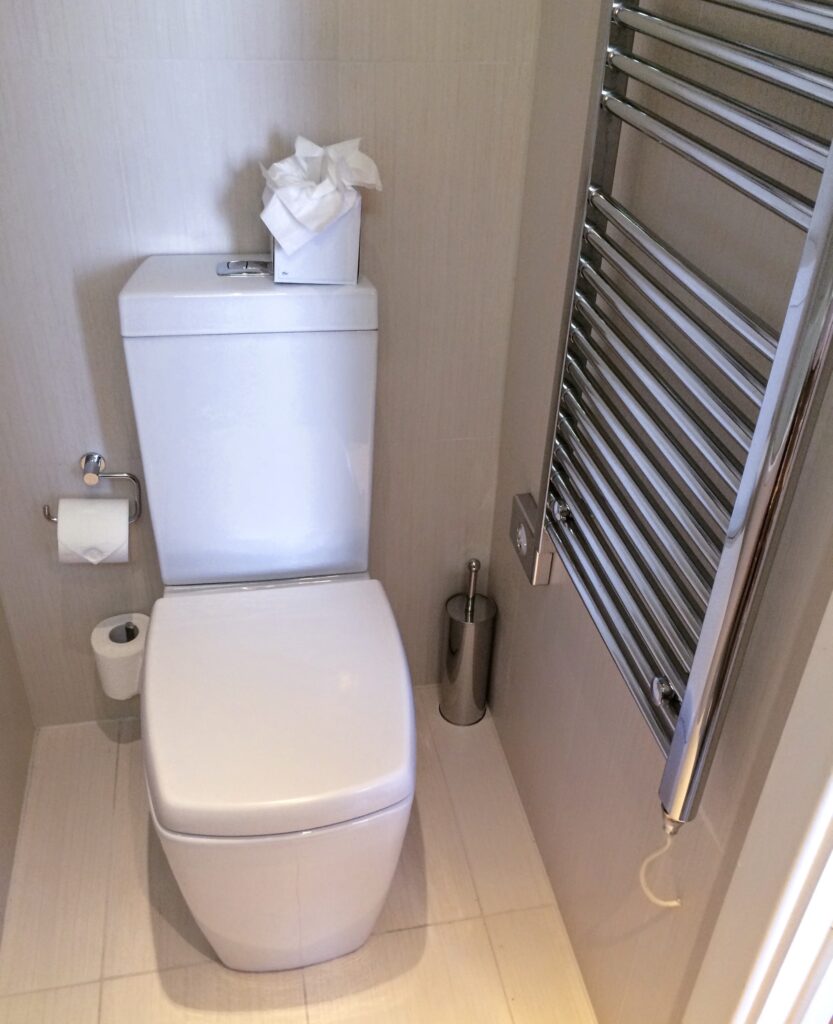
Quick answer: Budget for the toilet, installation, connection materials, removal and disposal—not just the fixture’s advertised price. Keep flange repairs, shutoff replacement and floor restoration separate until their condition is confirmed. One Seattle contractor’s July 2026 guide lists straightforward replacement labor at $300–$500, with the toilet purchased separately. That is a local planning reference, not a national average or a quote for your home. (bens.plumbing)
Scope: U.S. homeowners replacing an existing residential toilet. All prices below are U.S. dollars. Seattle pricing references were checked November 22, 2026.
1. Compare the installed scope, not the fixture price
A useful replacement budget separates what you are buying from what the plumber is doing.
Ask for these categories in every proposal:
| Budget category | What to have the contractor identify |
|---|---|
| Toilet and accessories | Exact model, bowl, tank where applicable, seat and required adapters |
| Installation | Removal, setting, connection and testing |
| Connection materials | New seal, mounting hardware and supply connector |
| Haul-away | Removal from the property and disposal |
| Conditional repairs | Shutoff, flange, drain connection or damaged floor |
| Administration | Applicable permit, inspection and tax treatment |
This is a comparison framework, not a promise that every contractor packages work this way. The FTC recommends written estimates describing the work, materials, completion date and price, and advises asking why bids differ substantially. (consumer.ftc.gov)
Published prices also need context. Lighthouse Plumbing reports approximately $650–$750 including tax on its 2026 Seattle invoices for resets or installations where the toilet was already on site. That is a different scope and evidence type from a general labor estimate. Neither figure establishes what another contractor should charge. (lighthouseplumbingllc.com)
Before comparing totals, ask: “Does this price deliver a working replacement and remove the old toilet, or does it cover installation only?”
2. Confirm rough-in compatibility before ordering
The rough-in is the distance from the finished wall behind the toilet to the center of its drain connection. TOTO’s installation documentation illustrates this measurement and, for the models covered, lists a supplied 12-inch outlet connection and separately purchased 10-inch and 14-inch alternatives. Those adapters are model-specific—not universal solutions. (totousa.com)
Have the installer confirm the actual measurement against the proposed model’s documentation. Do not substitute the edge of projecting baseboard trim for the finished-wall reference.
Send the contractor the exact model number before buying, and request confirmation of:
- Rough-in compatibility.
- Overall bowl and tank dimensions.
- Clearance around the existing supply valve.
- Any separately purchased connection adapter.
- The accessories included in the box.
Manufacturer documentation distinguishes supplied parts from other required installation materials, so a toilet package should not automatically be treated as a complete installation kit. (totousa.com)
Also ask the installer to review door movement, nearby fixtures and the existing toilet’s floor footprint. Treat these as pre-purchase checks: resolving a fit question before delivery is preferable to approving an unplanned change after removal.

3. Use WaterSense correctly when choosing a fixture
WaterSense is useful because labeled toilets are independently certified for water efficiency and flushing performance—not simply described by a seller as “water-saving.” EPA’s residential toilet guidance explains the certification requirement. (epa.gov)
There is an important current qualification. As checked November 22, 2026, EPA says Version 1.2 remains in effect, while the effective date of Version 2.0 is paused. Under Version 1.2:
- Single-flush toilets have an effective flush-volume limit of 1.28 gallons.
- Dual-flush toilets meet that limit using a weighted average of two reduced flushes and one full flush.
Therefore, do not assume every currently labeled dual-flush toilet has a full-flush volume of 1.28 gallons or less. Check the model’s published specifications. (epa.gov)
For separately sold tanks and bowls, verify the certified combination rather than matching components by appearance. EPA’s specification addresses certification of the complete toilet combination. (epa.gov)
Keep purchase and installation costs separate from operating-cost expectations. Do not deduct an assumed water-bill saving from the project budget; request any savings calculation separately, with its assumptions disclosed.
4. Clarify removal, disposal and the water connection
Ask for removal and disposal to be named separately. “Remove existing toilet” should not leave you guessing whether the old fixture will remain in your garage.
Have the proposal answer:
- Who carries the old toilet out?
- Is haul-away included?
- Who supplies the new connector and seal?
- Is shutoff replacement included or conditional?
- What happens if the existing valve cannot isolate the toilet?
The supply connector and shutoff are different components: the connector serves the toilet, while the shutoff controls its water supply. TOTO’s manual lists both among required installation materials. Its requirements should be checked for the particular model being installed. (totousa.com)
Request a condition check rather than asking the plumber to reuse everything automatically. Lighthouse identifies a shutoff that will not close as one factor that changes its toilet-installation price. (lighthouseplumbingllc.com)
For practical planning, tell the contractor about stairs, restricted parking, building access rules and whether this is the home’s only toilet. Ask whether those circumstances affect the price or arrangements for completing the work.
5. Separate flange repairs from floor restoration
The toilet flange connects the toilet to the drain and provides its floor anchorage. Oatey explains that damage or incorrect flange height can contribute to leaks or instability, with possible flooring and subfloor damage. A full inspection generally requires removing the toilet. (oatey.com)
These are related conditions, but they should not become one vague “repair as needed” charge.
For the flange, request: the defect found, proposed repair method, included materials and incremental charge.
For the floor, request: the affected area, whether the work concerns the structural subfloor or finish flooring, who performs it, and what restoration is excluded.
Repairing a flange ring, correcting flange height and replacing a damaged flange are not interchangeable descriptions. Oatey provides different repair approaches for different conditions; suitability depends on what remains sound. (oatey.com)
Do not authorize floor replacement solely because the old toilet rocked. Ask for photographs and an explanation of the findings. Equally, do not accept a new toilet as a substitute for addressing confirmed support damage.
A useful approval instruction is: “If concealed damage is found, document it and obtain approval for a separate repair scope before proceeding.”
6. Verify permits for the actual work
Do not assume toilet replacement is universally permit-free.
For example, Seattle’s published plumbing code generally requires permits for replacement work. Its exemptions include removing and reinstalling a toilet while clearing a stoppage, but distinguish that work from replacement or rearrangement of fixtures, pipes or valves. A reset and a replacement should not automatically be treated as the same permit category. (seattle.gov)
Ask the authority serving your address to confirm requirements for the proposed scope, particularly if the work expands to drain relocation, valve replacement or flange reconstruction.
Have the proposal state:
- Whether a permit is required.
- Who obtains it.
- Whether fees and inspection coordination are included.
- What happens if newly discovered work changes the requirements.
Where work is exempt, that does not necessarily exempt it from technical requirements; Seattle’s code expressly preserves code compliance for permit-exempt work. (seattle.gov)
Avoid inserting a generic permit allowance and treating it as a verified local fee.
7. Work through the base budget, then price contingencies separately
A worked example can show the budget structure without pretending to be a contractor quote.
Ben’s Plumbing’s guide, updated July 24, 2026, gives a fixture planning range of $200–$500 and straightforward Seattle replacement labor of $300–$500. Adding those published ranges produces:
| Straightforward replacement component | Planning amount |
|---|---|
| Toilet | $200–$500 |
| Replacement labor | $300–$500 |
| Arithmetic subtotal | $500–$1,000 |
This is an editorial calculation from that contractor’s published ranges—not an observed project total. Confirm connection materials, disposal, permits and taxes before using it as a complete budget. (bens.plumbing)
For a proposal where concealed conditions remain unknown, request a separate schedule:
| Proposal line | Pricing instruction |
|---|---|
| Base replacement | Fixed price for the named toilet and stated installation scope |
| Flange repair contingency | Separate incremental price for a defined repair, if applicable |
| Flange replacement contingency | Separate alternative price if repair proves unsuitable |
| Floor-repair contingency | Separately priced after the affected area and restoration scope are established |
| Additional visit | State whether any return charge applies |
The floor-repair price is deliberately not filled with a national allowance: the opened evidence does not establish a defensible price for your floor.
Ask the contractor to complete the applicable price lines before authorization. Where inspection is necessary first, agree on that inspection stage and its charge. Do not add a standalone flange-service price to a replacement bid without checking whether removal and resetting labor would be counted twice.
8. Check the proposal—and the completed installation
Before choosing a contractor, verify locally required credentials and request proof of insurance. Compare written estimates rather than selecting solely on the lowest advertised price, consistent with FTC guidance. (consumer.ftc.gov)
Use this final proposal checklist:
- The exact toilet model is identified.
- Owner-supplied and contractor-supplied items are distinguished.
- Removal and disposal responsibilities are clear.
- Connection materials are included or priced.
- Flange and floor work have separate approval rules.
- Permit and tax treatment are stated.
- Installation warranty terms are written down.
At completion, ask the installer to demonstrate flushing and refilling and check the supply connections and toilet base for leaks. Oatey’s installation guidance includes reconnecting the supply and leak testing after the toilet is reset. (oatey.com)
Confirm that the toilet feels stable, agreed accessories are fitted and the old fixture has been removed if haul-away was included. Keep the model information, invoice, photographs and applicable permit records together.
The best comparison is a defined working installation plus clearly controlled repair contingencies—not the lowest toilet price on a shelf.